# River API
River lets you sample from and fine-tune large hosted models through a single
Python client (`river-client`).
---
## Installation
```bash
pip install river-client
```
---
## Authentication
Create an API key on the **API Keys** page of the console, then expose it to
your environment:
```bash
export RIVER_API_KEY="rv_..."
```
The client reads your key explicitly — pass it when constructing the client:
```python
import os
import river_client as river
client = river.Client(api_key=os.environ["RIVER_API_KEY"])
```
The default endpoint is `api.river.ai` over TLS; you don't need to set anything
else.
---
## List available models
A minimal end-to-end check: connect, confirm the server is healthy, and print
the base models you can use.
```python
import os
import river_client as river
client = river.Client(api_key=os.environ["RIVER_API_KEY"])
print("healthy:", client.health_check())
for name in client.get_capabilities():
print(name)
```
Expected output:
```text
healthy: True
Qwen/Qwen3.6-35B-A3B-FP8
Qwen/Qwen3.5-397B-A17B-FP8
nvidia/Kimi-K2.6-NVFP4
nvidia/GLM-5.1-NVFP4
```
`get_capabilities()` returns the live list of model names you can pass as
`base_model` in later calls. Always read it at runtime rather than hard-coding —
the catalog changes over time.
---
## How requests work: submit, then poll
Most River operations (sampling, training steps, …) run on GPU workers and don't
finish instantly, so the API is **asynchronous** — you submit a request, the
server returns a `request_id`, and the result is fetched by polling that id.
### The high-level way (recommended)
The high-level methods do this for you. `client.sample(...)` **blocks** until the
result is ready and returns it directly — no ids, no polling:
```python
import os
import river_client as river
client = river.Client(api_key=os.environ["RIVER_API_KEY"])
BASE = "Qwen/Qwen3.6-35B-A3B-FP8"
samples = client.sample("What is 2 + 2? Answer briefly.", base_model=BASE, max_tokens=24)
print(repr(samples[0].text))
```
Expected output (the Qwen models are reasoning models, so the text includes a
`…` block):
```text
'\n\n\n\n\n\n4'
```
### The low-level way (submit + poll)
Under the hood that's two steps. The `submit_*` methods expose them: submit
returns immediately with a `request_id`, and `.result()` polls until the result
is ready.
```python
with client.session() as session:
# 1. Submit — returns immediately with a request_id.
pending = session.submit_sample("What is 2 + 2? Answer briefly.", base_model=BASE, max_tokens=24)
print("request_id:", pending.request_id)
# 2. Poll — .result() returns the same list[list[Sample]] as client.sample().
groups = pending.result()
print(repr(groups[0][0].text))
```
Expected output:
```text
request_id: d8461f9d-8269-4410-bce1-39bfeee97abc
'\n\n\n\n\n\n4'
```
Each request gets its own `request_id` (a UUID) — yours will differ. Submitting
several requests before polling lets independent work run in parallel; we'll use
that later for throughput.
---
## Supervised fine-tuning (SFT)
Let's actually train a model. The task: **prefix `test-` to every word** of the
input (e.g. `"hello world"` → `"test-hello test-world"`). It's a trivial pattern,
so a tiny dataset and ~15 steps are enough to learn it — and to verify the whole
training loop end to end.
### 1. Build a tiny dataset
Each example is a `(prompt, completion)` pair. We tokenize both and concatenate
them into one `input_ids` sequence. Per-token `weights` mask the prompt with
`0.0` so the loss is taken **only on the completion**, and `target_tokens` is the
next-token target at each position (position `i` predicts `ids[i+1]`, so the mask
is offset by one).
```python
import os
import river_client as river
from transformers import AutoTokenizer
client = river.Client(api_key=os.environ["RIVER_API_KEY"])
BASE = "Qwen/Qwen3.6-35B-A3B-FP8"
tok = AutoTokenizer.from_pretrained(BASE)
EOS = tok.eos_token_id
def target_for(x):
return " ".join("test-" + w for w in x.split())
train_inputs = [
"hello world",
"good morning sunshine",
"the quick brown fox",
"i love programming",
"open the pod bay doors",
"river flows to the sea",
]
def render(x):
return f"Input: {x}\nOutput:"
def make_datum(x):
prompt_ids = tok(render(x), add_special_tokens=False)["input_ids"]
completion_ids = tok(" " + target_for(x), add_special_tokens=False)["input_ids"] + [EOS]
ids = prompt_ids + completion_ids
target_tokens = ids[1:] + [EOS]
weights = [0.0] * (len(prompt_ids) - 1) + [1.0] * (len(completion_ids) + 1)
return {"input_ids": ids, "target_tokens": target_tokens, "weights": weights}
batch = [make_datum(x) for x in train_inputs]
```
### 2. Create a session and train
`client.session()` opens a training session (a context manager that frees the
model on exit). `session.create_model(...)` creates a LoRA model to train, sized
by `river.LoraConfig(rank=...)` (rank 1–32). Each step:
`forward_backward(data, loss_fn="cross_entropy")` runs the forward pass and
accumulates gradients (returns `.metrics["loss"]`), and `optim_step(lr=...)`
applies an **AdamW** update and advances `model.step`.
```python
with client.session(project="sft-prefix") as session:
model = session.create_model(base_model=BASE, lora=river.LoraConfig(rank=32))
print("model_id:", model.model_id)
for step in range(15):
fb = model.forward_backward(batch, loss_fn="cross_entropy")
model.optim_step(lr=2e-4, grad_clip_norm=1.0)
print(f"step {model.step:2d} loss={fb.metrics['loss']:.4f}")
```
The loss collapses within a handful of steps:
```text
model_id: ba1c7208-3c2a-442d-98f2-8aea7bb6980e:model:1
step 1 loss=34.4821
step 2 loss=19.3106
step 3 loss=9.1079
step 4 loss=3.2211
step 5 loss=0.1230
step 6 loss=0.0441
step 7 loss=0.0037
step 8 loss=0.0001
...
step 15 loss=0.0000
```
### 3. Sample from the trained model
`model.sample(prompt, ...)` generates from the model's **current in-memory
weights** (no checkpoint needed) and returns `list[list[Sample]]` (per-prompt ×
per-sample). We sample greedily (`temperature=0.0`), still inside the session:
```python
for x in ["hello world", "the lazy dog sleeps"]:
out = model.sample(render(x), max_tokens=16, temperature=0.0, stop=["\n"])
print(f"{x!r} -> {out[0][0].text!r}")
```
It learned the rule, and even generalizes to the unseen `"the lazy dog sleeps"`:
```text
'hello world' -> ' test-hello test-world'
'the lazy dog sleeps' -> ' test-the test-lazy test-dog test-sleeps'
```
### 4. Save a checkpoint and sample from it
`model.save_weights(name, mode="inference")` saves the LoRA as a checkpoint, and
`session.sample(..., checkpoint=ckpt)` samples from a saved checkpoint — it loads
the LoRA, generates, then unloads (no live model needed):
```python
ckpt = model.save_weights("prefix", mode="inference")
print("saved:", ckpt.path)
for x in ["hello world", "the lazy dog sleeps"]:
out = session.sample(render(x), base_model=BASE, checkpoint=ckpt,
max_tokens=16, temperature=0.0, stop=["\n"])
print(f"{x!r} -> {out[0][0].text!r}")
```
The checkpoint reproduces the same behavior:
```text
saved: river://6501216f-c72d-4186-a37c-b65bee62bf58/sampler_weights/prefix
'hello world' -> ' test-hello test-world'
'the lazy dog sleeps' -> ' test-the test-lazy test-dog test-sleeps'
```
Install the dependencies and run the whole thing:
```bash
pip install river-client
export RIVER_API_KEY="rv_..."
python sft.py
```
Full runnable script (sft.py)
```python
import os
import river_client as river
from transformers import AutoTokenizer
client = river.Client(api_key=os.environ["RIVER_API_KEY"])
BASE = "Qwen/Qwen3.6-35B-A3B-FP8"
tok = AutoTokenizer.from_pretrained(BASE)
EOS = tok.eos_token_id
def target_for(x):
return " ".join("test-" + w for w in x.split())
train_inputs = [
"hello world",
"good morning sunshine",
"the quick brown fox",
"i love programming",
"open the pod bay doors",
"river flows to the sea",
]
def render(x):
return f"Input: {x}\nOutput:"
def make_datum(x):
prompt_ids = tok(render(x), add_special_tokens=False)["input_ids"]
completion_ids = tok(" " + target_for(x), add_special_tokens=False)["input_ids"] + [EOS]
ids = prompt_ids + completion_ids
target_tokens = ids[1:] + [EOS]
weights = [0.0] * (len(prompt_ids) - 1) + [1.0] * (len(completion_ids) + 1)
return {"input_ids": ids, "target_tokens": target_tokens, "weights": weights}
batch = [make_datum(x) for x in train_inputs]
with client.session(project="sft-prefix") as session:
model = session.create_model(base_model=BASE, lora=river.LoraConfig(rank=32))
print("model_id:", model.model_id)
# Train
for step in range(15):
fb = model.forward_backward(batch, loss_fn="cross_entropy")
model.optim_step(lr=2e-4, grad_clip_norm=1.0)
print(f"step {model.step:2d} loss={fb.metrics['loss']:.4f}")
# Sample from the live trained weights
for x in ["hello world", "the lazy dog sleeps"]:
out = model.sample(render(x), max_tokens=16, temperature=0.0, stop=["\n"])
print(f"{x!r} -> {out[0][0].text!r}")
# Save an inference checkpoint and sample from it
ckpt = model.save_weights("prefix", mode="inference")
print("saved:", ckpt.path)
for x in ["hello world", "the lazy dog sleeps"]:
out = session.sample(render(x), base_model=BASE, checkpoint=ckpt,
max_tokens=16, temperature=0.0, stop=["\n"])
print(f"{x!r} -> {out[0][0].text!r}")
```
---
## LoRA configuration
`session.create_model(..., lora=river.LoraConfig(...))` controls the LoRA adapter
that gets trained:
```python
river.LoraConfig(
rank=16, # adapter rank — must be 1–32 (32 is the current max)
train_attn=True, # adapt the attention projections
train_mlp=True, # adapt the MLP / expert projections
train_unembed=False, # also adapt the output (unembedding) layer
seed=None, # optional seed for reproducible LoRA init
)
```
- **`rank`** — the adapter's capacity. **The maximum supported rank is 32**; a
larger value is rejected.
- **`train_attn` / `train_mlp`** — which weight groups receive LoRA adapters
(attention vs. MLP/expert layers). Both default on.
- **`train_unembed`** — also adapt the output/unembedding layer. Off by default;
RL runs often turn it on.
---
## Reinforcement learning (importance sampling)
SFT imitates fixed answers; RL optimizes against a **reward**. Here we train on
GSM8K math: for each question we sample a group of answers, reward the ones whose
`\boxed{...}` matches the ground truth, turn rewards into **group-relative
advantages** (GRPO-style), and update the policy with the **`importance_sampling`**
loss.
**Key detail — inputs to the `importance_sampling` loss.** It's an off-policy
policy gradient. Each `forward_backward(loss_fn="importance_sampling")` datum
carries three aligned per-token arrays:
- **`input_ids`** — the full `prompt + completion` token sequence.
- **`old_logprobs`** — the behavior policy's per-token logprobs, taken straight
from the sampler (`Sample.logprobs`). These define the importance ratio between
the current policy and the policy that generated the sample.
- **`advantages`** — the per-token advantage (here, the group-relative reward).
(`attention_mask` marks the valid tokens.) The arrays are built per **prediction
position**:
```python
groups = model.sample(prompts, num_samples=group_size, max_tokens=128, stop=["<|im_end|>"])
train_data = []
for prompt_tokens, samples, answer in zip(prompt_token_lists, groups, answers):
rewards = [get_reward(s.text, answer) for s in samples] # 1.0 if \boxed{} matches
mean_r = sum(rewards) / len(rewards)
if all(r == mean_r for r in rewards):
continue # skip zero-advantage groups
ob = len(prompt_tokens) # prompt length
for s, r in zip(samples, rewards):
adv = r - mean_r # group-relative advantage
train_data.append({
"input_ids": prompt_tokens + s.tokens,
"attention_mask": [1] * (ob + len(s.tokens)),
"old_logprobs": [0.0] * (ob - 1) + s.logprobs + [0.0], # sampler logprobs over completion
"advantages": [0.0] * (ob - 1) + [adv] * len(s.tokens) + [0.0],
})
model.forward_backward(train_data, loss_fn="importance_sampling")
model.optim_step(lr=4e-5, beta1=0.9, beta2=0.95, eps=1e-8) # AdamW update
```
`optim_step` applies an **AdamW** update (Adam with decoupled weight decay,
default `0.01`); here we use `beta1=0.9, beta2=0.95`.
The completion-aligned arrays start at `ob - 1` (the last prompt position is what
predicts the first response token) and end with a trailing `0.0` for the
no-next-token slot. The prompt positions are `0.0`, so loss/advantage apply only
to generated tokens. `target_tokens` is omitted — the server shifts `input_ids`
by one automatically.
This run uses `batch_size=256`, `group_size=4`, `max_tokens=128`, `lora_rank=8`,
and disables the model's thinking mode, on `Qwen/Qwen3.6-35B-A3B-FP8` — one epoch
over GSM8K's 7,473 training questions is **29 steps**. The complete, runnable
script is below.
Install the dependencies and run it:
```bash
pip install river-client datasets transformers jinja2
export RIVER_API_KEY="rv_..."
python rl.py
```
Full runnable script (rl.py)
```python
import os, re
import datasets
import river_client as river
from transformers import AutoTokenizer
MODEL = "Qwen/Qwen3.6-35B-A3B-FP8"
BATCH_SIZE, GROUP_SIZE, MAX_TOKENS, LORA_RANK, LR = 256, 4, 128, 8, 4e-5
# ── GSM8K reward: 1.0 if the last \boxed{...} matches the ground-truth number ──
def extract_boxed(text):
out, stack = [], []
for i, ch in enumerate(text):
if ch == "{":
stack.append(i)
elif ch == "}" and stack:
s = stack.pop()
if text[:s].endswith("\\boxed"):
out.append(text[s + 1 : i])
return out[-1] if out else None
def gsm8k_gt(answer_field):
for line in reversed(answer_field.splitlines()):
if line.strip().startswith("####"):
return line.strip()[4:].strip().lstrip(":").replace(",", "").strip()
return answer_field.strip()
def get_reward(response, answer_field):
ext = extract_boxed(response)
if ext is None:
return 0.0
def norm(s):
s = s.replace(",", "").replace("$", "").replace(" ", "")
m = re.search(r"-?\d+\.?\d*", s)
return m.group(0) if m else s
try:
return 1.0 if float(norm(ext)) == float(norm(gsm8k_gt(answer_field))) else 0.0
except ValueError:
return 1.0 if norm(ext) == norm(gsm8k_gt(answer_field)) else 0.0
tok = AutoTokenizer.from_pretrained(MODEL)
train_ds = datasets.load_dataset("openai/gsm8k", "main")["train"]
suffix = " Provide a numerical answer without units, written inside \\boxed{}."
fewshot = [
{"role": "user", "content": "How many r's are in strawberry?" + suffix},
{"role": "assistant", "content": (
"Let's spell the word out and number all the letters: "
"1) s 2) t 3) r 4) a 5) w 6) b 7) e 8) r 9) r 10) y. "
"We have r's at positions 3, 8, and 9. \\boxed{3}")},
]
client = river.Client(api_key=os.environ["RIVER_API_KEY"])
n_batches = len(train_ds) // BATCH_SIZE # 29
with client.session() as session:
model = session.create_model(
base_model=MODEL, lora=river.LoraConfig(rank=LORA_RANK, train_unembed=True),
)
for step in range(n_batches):
rows = train_ds.select(range(step * BATCH_SIZE, step * BATCH_SIZE + BATCH_SIZE))
prompts, prompt_tok = [], []
for q in rows["question"]:
msgs = [*fewshot, {"role": "user", "content": q + suffix}]
text = tok.apply_chat_template(
msgs, tokenize=False, add_generation_prompt=True, enable_thinking=False)
prompts.append(text)
prompt_tok.append(tok.encode(text, add_special_tokens=False))
groups = model.sample(
prompts=prompts, num_samples=GROUP_SIZE, max_tokens=MAX_TOKENS,
stop=["<|im_end|>"], seed=step * len(prompts) * GROUP_SIZE)
train_data, all_rewards = [], []
for ptok, samples, answer in zip(prompt_tok, groups, rows["answer"]):
rewards = [get_reward(s.text, answer) for s in samples]
mean_r = sum(rewards) / len(rewards)
all_rewards.append(mean_r)
if all(r == mean_r for r in rewards):
continue
ob = len(ptok)
for s, r in zip(samples, rewards):
adv = r - mean_r
train_data.append({
"input_ids": ptok + s.tokens,
"attention_mask": [1] * (ob + len(s.tokens)),
"old_logprobs": [0.0] * (ob - 1) + s.logprobs + [0.0],
"advantages": [0.0] * (ob - 1) + [adv] * len(s.tokens) + [0.0],
})
if train_data:
model.forward_backward(train_data, loss_fn="importance_sampling")
model.optim_step(lr=LR, beta1=0.9, beta2=0.95, eps=1e-8)
reward = sum(all_rewards) / len(all_rewards) if all_rewards else 0.0
print(f"[step {step:2d}] reward={reward:.3f}")
```
### Training run
Running the script above for one full epoch (29 steps) on
`Qwen/Qwen3.6-35B-A3B-FP8`, the mean GSM8K reward climbs from ~0.04 to ~0.93 —
the model goes from almost never solving a problem to getting ~9 out of 10
right:
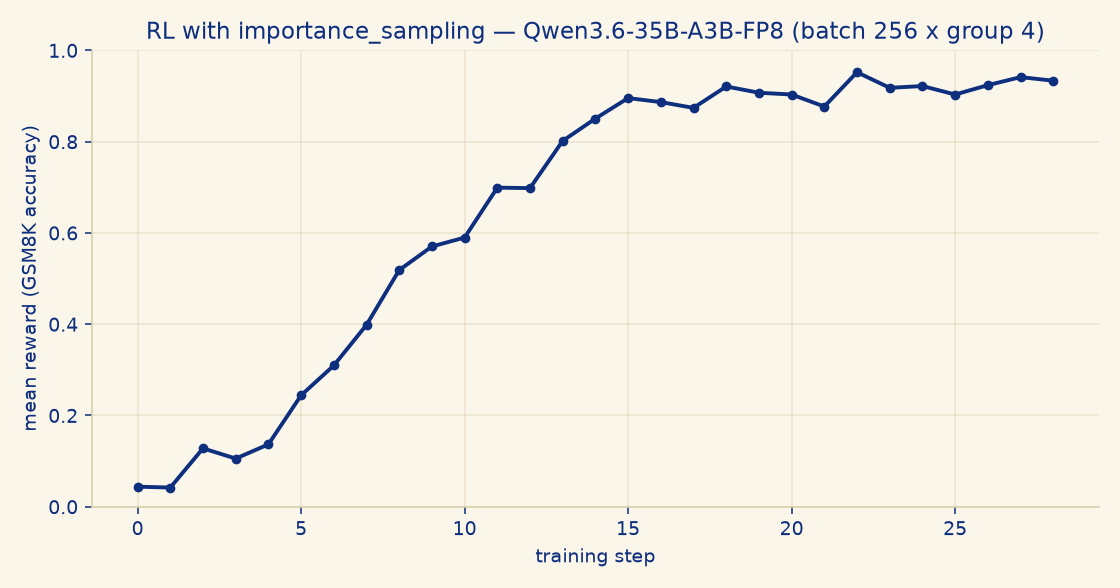
Per-step reward (all 29 steps)
```text
[step 0] reward=0.044
[step 1] reward=0.042
[step 2] reward=0.128
[step 3] reward=0.105
[step 4] reward=0.137
[step 5] reward=0.244
[step 6] reward=0.310
[step 7] reward=0.398
[step 8] reward=0.519
[step 9] reward=0.570
[step 10] reward=0.590
[step 11] reward=0.699
[step 12] reward=0.698
[step 13] reward=0.802
[step 14] reward=0.851
[step 15] reward=0.896
[step 16] reward=0.887
[step 17] reward=0.874
[step 18] reward=0.921
[step 19] reward=0.907
[step 20] reward=0.903
[step 21] reward=0.877
[step 22] reward=0.952
[step 23] reward=0.918
[step 24] reward=0.922
[step 25] reward=0.903
[step 26] reward=0.924
[step 27] reward=0.941
[step 28] reward=0.934
```
---
## Loss functions
Pass the loss name as `loss_fn` to `forward_backward`, and any loss-specific
arguments as keyword arguments, e.g.
`model.forward_backward(data, loss_fn="cispo", eps_max=8.0)`.
> **All losses are summed over tokens** (not averaged). Each token's contribution
> is scaled by its per-token field — **`weights`** for `cross_entropy`,
> **`advantages`** for the RL losses. Setting a token's value to `0.0` removes it
> from the loss; larger magnitudes weight it more. (This is why masking the prompt
> with `0.0` restricts learning to the completion, and why the loss magnitude
> grows with the number of contributing tokens.)
| `loss_fn` | Use | Required per-datum fields | Arguments (default) |
| --- | --- | --- | --- |
| `cross_entropy` | Supervised fine-tuning | `input_ids`, `weights` (`target_tokens` optional) | — |
| `importance_sampling` | Off-policy policy gradient | `input_ids`, `old_logprobs`, `advantages` | — |
| `ppo` | Clipped policy optimization | `input_ids`, `old_logprobs`, `advantages` | `clip_low` (0.2), `clip_high` (0.2) |
| `cispo` | Clipped importance-sampling PO | `input_ids`, `old_logprobs`, `advantages` | `eps_max` (6.0) |
| `dro` | Direct reward optimization | `input_ids`, `old_logprobs`, `advantages` | `beta` (0.05) |
What each one is, at a high level:
- **`cross_entropy`** — standard supervised next-token loss. Trains the model to
imitate the target tokens; `weights` choose which tokens count (e.g. `1.0` on
the completion, `0.0` on the prompt). This is the SFT loss.
- **`importance_sampling`** — the basic off-policy policy gradient. Each token's
update is scaled by its `advantage` and by the importance ratio between the
current policy and the sampler that produced it (`old_logprobs`). Simplest RL
loss; no clipping, so it can be noisy if the policy drifts far from the sampler.
- **`ppo`** — importance sampling with the ratio **clipped** to
`[1 − clip_low, 1 + clip_high]`. The clip removes the incentive to move any
single token's probability too far in one step, which keeps updates stable.
- **`cispo`** — clipped importance-sampling policy optimization. Instead of
clipping the objective, it **caps the importance ratio at `eps_max`** while
letting the gradient keep flowing through `log π`. Robust when samples are well
off-policy (the approach used in ScaleRL-style training).
- **`dro`** — direct reward optimization. Adds a quadratic **anchor** (strength
`beta`) pulling the policy toward the sampler's logprobs while it chases
reward, trading a bit of reward for stability.
All four RL losses consume the same per-datum fields (`old_logprobs` +
`advantages`) and differ only in how they shape the update.
> **Custom loss functions aren't supported yet.** Use one of the built-in losses
> above; if you need a custom objective, reach out and we'll help.
---
## Throughput and batch size
Training and inference run on an **autoscaling worker pool** — River scales
capacity up and down automatically to match your load. Because there's fixed
per-step overhead, **bigger batches generally give higher throughput**: packing
more prompts/sequences into a single `forward_backward` or `sample` call
amortizes that overhead.
So don't be shy with batch size — you can push to **millions of total tokens per
step** and the system will scale to handle it. If you're optimizing throughput,
increase the batch (more prompts × longer sequences) and measure tokens/second
rather than sending many small requests.
---
## Saving and resuming (checkpoints)
`model.save_weights(name, mode=...)` writes the model's current weights to a
`river://` checkpoint and returns a `Checkpoint` (`.path`, `.step`,
`.checkpoint_type`). Two modes:
- `mode="training"` — includes optimizer state, so you can **resume training**
later (and it can still be sampled from).
- `mode="inference"` — PEFT weights only; smaller, for serving / sampling.
**Resume:** the checkpoint `river://` path is all you need — it's durable, so you
can resume in a **completely separate session** (or process, or machine) by
passing the path to `session.create_model(checkpoint=...)`. For a training
checkpoint this restores the weights **and** optimizer state.
The example below runs **two independent sessions**: the first trains Model A on
one 100-token random sequence and saves a checkpoint; the second knows nothing
but the checkpoint path, and resumes from it. (We use random tokens purely to
watch the loss continue across the resume — there's nothing meaningful to
sample.)
```python
import os
import random
import river_client as river
client = river.Client(api_key=os.environ["RIVER_API_KEY"])
BASE = "Qwen/Qwen3.6-35B-A3B-FP8"
# One fixed 100-token random sequence for the model to memorize.
random.seed(0)
ids = [random.randint(1, 32000) for _ in range(100)]
data = [{"input_ids": ids, "target_tokens": ids[1:] + [ids[0]], "weights": [1.0] * 100}]
# ── Session 1: train and save a checkpoint ──
with client.session(project="ckpt-a") as session:
a = session.create_model(base_model=BASE, lora=river.LoraConfig(rank=8))
for _ in range(5):
r = a.forward_backward(data, loss_fn="cross_entropy")
a.optim_step(lr=1e-4)
print(f"A step {a.step} loss={r.metrics['loss']:.1f}")
ckpt = a.save_weights("ckpt_step5", mode="training")
print("saved:", ckpt.path)
checkpoint_path = ckpt.path # the only thing the next session needs
# ── Session 2 (separate): resume from just the checkpoint path ──
with client.session(project="ckpt-b") as session:
b = session.create_model(
base_model=BASE, lora=river.LoraConfig(rank=8), checkpoint=checkpoint_path,
)
rb = b.forward_backward(data, loss_fn="cross_entropy")
b.optim_step(lr=1e-4)
print(f"B first loss={rb.metrics['loss']:.1f}")
```
Output:
```text
A step 1 loss=1226.5
A step 2 loss=1207.4
A step 3 loss=1182.6
A step 4 loss=1156.9
A step 5 loss=1139.0
saved: river://2c1ca407-1a5a-4228-bdad-0a70840b7841/weights/ckpt_step5
B first loss=1117.1
```
Even though Model B is in a fresh session and only has the path, its first loss
(`1117.1`) continues right where Model A left off (`1139.0`) — rather than jumping
back near the starting loss. That's the checkpoint's weights and optimizer state
being restored. (The client-side `model.step` counter starts at `0` again, since a
bare path carries no step metadata; pass the `Checkpoint` object instead if you
want the step restored too.)
To **sample** from a saved checkpoint instead of resuming training, use
`session.sample(..., checkpoint=ckpt)` — shown in
[Supervised fine-tuning](#supervised-fine-tuning-sft) step 4.